
You’ve likely driven down Kearny Villa Road, Linda Vista Road, and Convoy Street dozens (or even hundreds) of times without giving much thought to their history. Your first thoughts of Kearny Mesa probably flit to the Convoy District and its reputation as an Asian food hub, flanked by industrial warehouses and office complexes emblematic of the area.
But the land now occupied by frontage roads, brown, boxy office buildings, and award-winning ramen restaurants used to be something much different.
Dry, dusty land covered in leathery chaparral stretched for miles. The area was called the Linda Vista mesa. It was early 1917, and the United States was on the precipice of war. By April, the nation had entered World War I, ready to battle Germany, and needed a training site.

San Diego’s civic boosters lobbied hard in pitching the Linda Vista mesa area. The San Diego Union wrote, “No city can better serve the nation than ours, where every day is a training day.”

The Army agreed. In May, war inspectors surveyed the mesa and found it ideal: flat, open, close to rail and port, with plenty of room to drill soldiers. Plus, San Diego Consolidated Gas and Electric promised to provide electricity. Its proximity to the Santa Fe Depot
So, on July 18, 1917, the site was officially designated Camp Kearny, named after Brigadier General Stephen Watts Kearny. Kearny had marched into California during the Mexican–American War in 1846 and played a pivotal role in bringing the state under U.S. control.
Parts of Camp Kearny, pronounced “Car-nee,” would become what we now know as Kearny Mesa.
From Sage and Dust to Development: The Rise of Camp Kearny
The camp was built at the pace of a rocket launch, fast and furious. Fitting for a neighborhood that would eventually become one of the epicenters of aerospace and rocket missile component manufacturing and testing.
In only three months, a city complete with 1,200 buildings, including a hospital complex, barracks, a theater, officers’ quarters, a post office, a jail, and even a YMCA, was built. The main drag, Camp Kearny Boulevard, became what we now know as Kearny Villa Road. The construction of Kearny Villa Road and Linda Vista Road made travel from the city much more accessible.
Dust and Drills on the Kearny Mesa
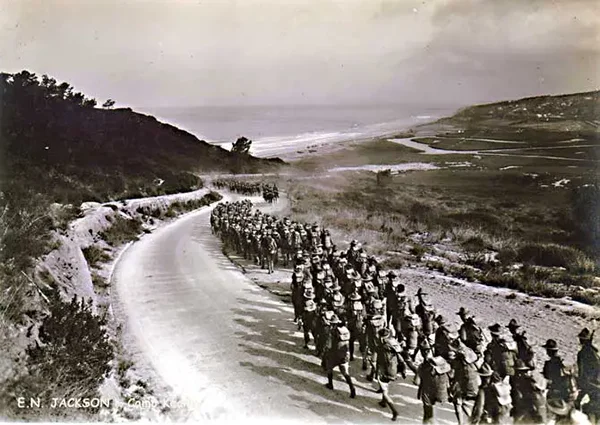
The first 5,000 soldiers arrived in September 1917, followed shortly thereafter by thousands more. Ultimately, 23,000 men formed the 40th Infantry Division, affectionately known as the Sunshine Division.
However, the recruits quickly discovered that Camp Kearny’s sunshine came with consequences. Mornings were crisp, afternoons blindingly hot, and the wind whipped dust into every crevice of tent and uniform.
The men were drilled from dawn until evening. Days were filled with long marches, rifle exercises, and field maneuvers across the dry ridges toward Miramar. From above, their formations looked like moving lines of ants, barely visible through a thick veil of brown dust.
The San Diego Sun wrote in October 1917 of the dust at Camp Kearny, “It is omnipresent and omnivorous. The latter means that it devours everything in its path.”
Despite the hardships, Camp Kearny was far from bleak. The camp had a theater and an auditorium, where soldiers could watch boxing matches or comedy reviews. Camp had a skating rink and a shooting gallery. The Commission on Training Camp Activities was formed for one purpose—to make life normal and wholesome for the soldiers. That also meant keeping alcohol and prostitution at bay.
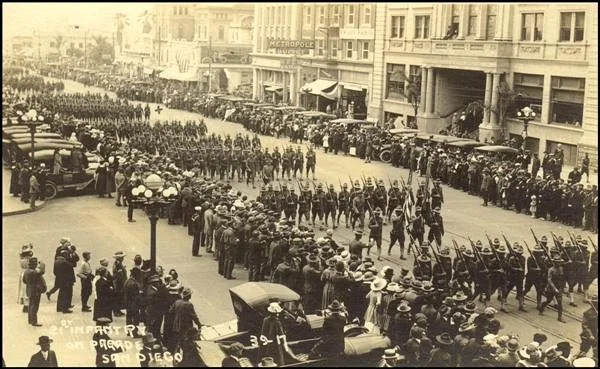
The quick rise of Camp Kearny was brought to a swift end only a year later, when the war ended with the Armistice of November 11, 1918. Many soldiers who trained for war never actually participated. And Camp Kearny pivoted from a training site to a processing center for troops returning home. The camp was decommissioned for good in October 1920.
The Lasting Military Presence in Kearny Mesa
Kearny Mesa and its surrounding area, Miramar, also maintained a strong military presence during World War II. Part of what was Camp Kearny became Camp Elliott, a Marine Corps base that served as a training site for mechanized and motorized units.
During this time, the nearby network of roads in Kearny Mesa likely supported heavy military traffic or large motor convoys, possibly inspiring the name Convoy Street.
Camp Kearny and Camp Elliott still remain etched in San Diego’s military history and its present, with their remains now part of the Marine Corps Air Station in Miramar. While Kearny Mesa no longer housed an active military site, it continued to support the military through its array of aerospace and defense manufacturers, including General Dynamics, Northrop Grumman, Boeing, and Cubic.
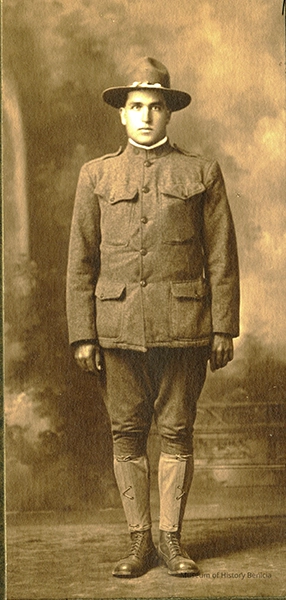
Next time you travel down Linda Vista Road, as it turns into Convoy Street, you just might feel the ghosts of the city’s soldiers behind you.
Sources:
San Diego History, Kearny Mesa Community Planning
YMCA Photo Courtesy: Digital Commonwealth






Great Story Tanja!
Thank You.
Thank you! There’s so much more to it but it would have been a novel. Maybe I’ll do a history series if everyone enjoys them.
Great piece of history to learn.
Glad you enjoyed it!