


A brief history of Claire Tavares and the Clairemont of yesterday and today
Special thanks to Clairemont Town Council for images used in this post.
If you live in San Diego, you’re undoubtedly familiar with the annual phenomenon known as May Gray/June Gloom. And if you live in Clairemont, you know we get to bask in the sun as it breaks through the midday gray well before it rolls down the hill toward our westerly neighbors in PB.
That sunshine up on the hill was the inspiration behind Clairemont.
Post World War II, Clairemont was largely devoid of development. Carlos Tavares, a land developer, and his business partner, Lou Burgener, were seeking a location to develop a planned residential community.
It was Carlos’s wife, Claire, who suggested the area now known as Clairemont. “Why don’t we go look for it over there where the sun shines?” she said to Carlos.
Hard to believe it now, but Carlos said, “It’s too far from San Diego.” However, Claire’s four-word retort sealed the deal. “I don’t think so,” she said, and off they went to the hills where the sun shone.
San Diego’s Largest Planned Community

Besides determining its location, Claire played a significant role in the design inspiration of Clairemont itself. Since the intent of Clairemont was to be a residential housing community geared toward young families, Claire suggested cul-de-sacs so children could play in the streets without fear of cars driving through.
This was a shift in mindset from the traditional grid design of most planned communities. And so in the early 1950s, construction began, turning Clairemont into one of the country’s largest planned communities. And paying homage to his wife, Carlos named the neighborhood Clairemont. It was also known as the “Village Within a City.”
A Steal of a Deal
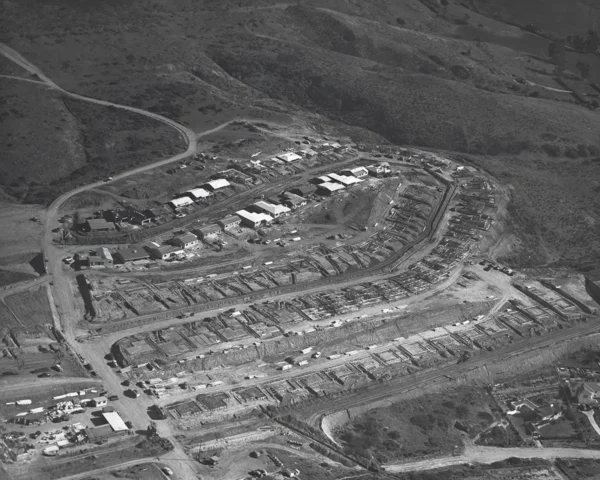
The first 500 homes were built in South Clairemont and offered buyers stylish ceramic tiling, large windows, two-car garages, and spacious yards. The going prices? Approximately $13,000 to $20,000. That equates to roughly $178,000 to $274,000 in today’s money.
The first phase of the development morphed into many more. Houses were being built at breakneck speed — up to seven in a single day. Clairemont’s population swelled in a matter of a few short years. By 1955, 7,000 new homes accommodated 25,000 residents.
The home prices of a postwar past are a far cry from today’s average Clairemont home price of nearly $1.2 million. What hasn’t changed in the past 75 years is that Clairemont remains a family community, something that was near and dear to Claire Tavares’ heart.
An Imperfect Past
While the Clairemont of yesterday sounds idyllic, it is not without a marred history. Racial disparity was omnipresent in the 1950s, and it was literally etched into history via property deed covenants. These covenants barred non-Whites from buying property in communities like Clairemont.

Discriminatory covenants were certainly not unique to Clairemont. Throughout California, racial restrictions primarily targeted Hispanics, Asians, and Blacks from purchasing homes in specific neighborhoods, contributing to the proliferation of their White population.
This is an example of one such covenant in San Diego: “No part of said property, or any buildings thereon, shall be used or occupied by any person not belonging to the Caucasian race, either as owner, lessee, licensee, tenant, or in any other capacity than that of servant or employee.”
The Supreme Court abolished these covenants in 1948, but they lingered on for years to come. Although not enforced, some remain on the property deeds to this day.
The Tapestry of Clairemont Residents Today
However, today’s Clairemont looks decidedly different. Nearly half its residents are non-White, and many of them are proud homeowners and small business owners in Clairemont. Diversity is now a hallmark of Clairemont, and not an anathema.
This has contributed to Clairemont’s reputation for having an ethnic food scene that rivals most other San Diego communities. From mom-and-pop taco shops to ramen houses to Middle Eastern markets, flavors of the world abound in this neighborhood.
From Boomtown to Under the Radar
After the boom of the 1950s and 1960s, and even into the 1970s, Clairemont’s population growth stagnated, experiencing its first decline by 1980. Part of this decline was attributed to families having fewer children. Interestingly, while Clairemont saw a 6 percent decrease in population, San Diego as a whole exploded by nearly 26 percent.
Since then, according to U.S. Census Bureau statistics, population growth in Clairemont (specifically 92117) has remained relatively stagnant. The population remained relatively stable, hovering around 51,000 residents, in 2000, 2010, and 2020. In fact, at an even more granular level, the area saw a decline of roughly 6 percent from 2018 to 2023, with an expected one percent decrease in 2025.
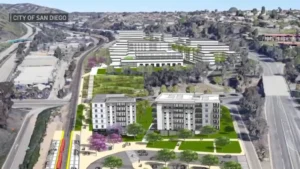
However, with recent new housing developments on the horizon and the proliferation of additional dwelling units (ADUs), the decline may trend back upward in the very near future.
After all, Clairemont’s rolling canyons, scenic hiking trails, and close proximity to, well, everywhere in the city, make Clairemont the belle of the ball.
You Are My Sunshine
It’s curious to wonder about what would have become of the place up the hill where the sun shines had Claire Tavares not urged her husband to consider it for his massive development project so long ago.
Fortunately, we don’t have to wonder, thanks to Claire Tavares. And this year, Clairemont celebrates its 75th official year. Happy birthday to our home.
Carlos passed away in 1975, and Claire in 2014. They both left an indelible mark on the history of San Diego. Claire’s obituary highlighted her passion for philanthropy and her generosity toward those less fortunate in life.
By the way, Claire had a hand in the naming of another San Diego community. San Carlos is named after her beloved husband.
Sources:









Nice article Tanja! I learned something new about my childhood neighborhood.
Great article. I grew up in Clairemont since 1965. I now live in Tierrasanta. Island in the hills. But, clairemont is my home. I’m always there.